



From a Single Corn Stalk to the Automotive Cabin: The Green Restructuring of the Bio-Based Supply Chain



PURE®, Making Materials More Sustainable
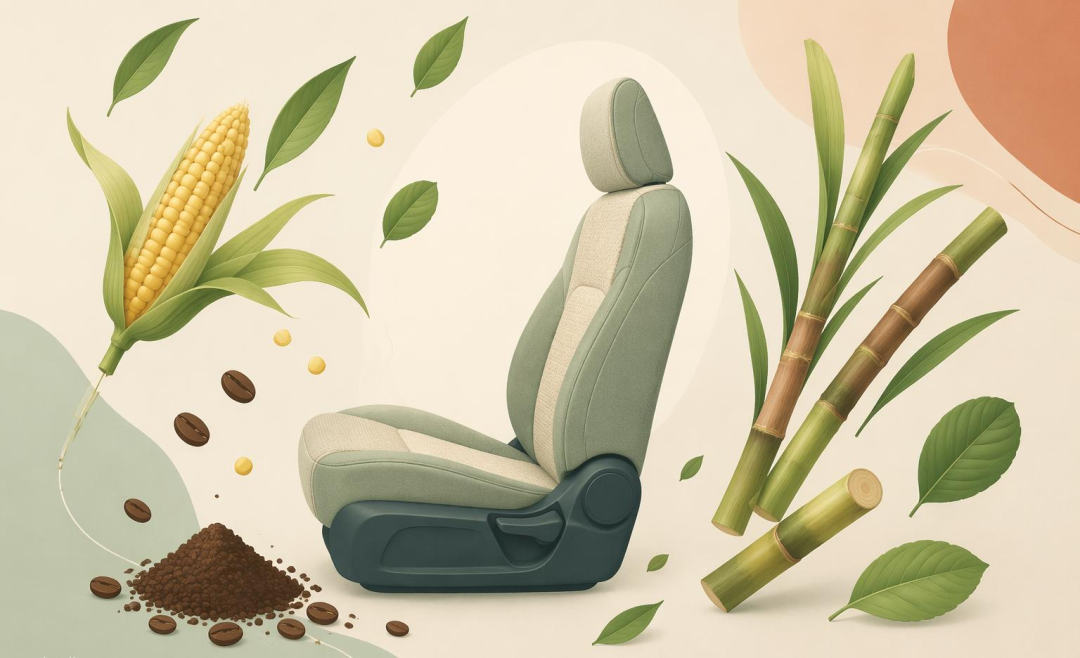
Imagine the dealership sales consultant telling you, "This seat is made from corn and sugarcane, and the interior contains not a single molecule of petroleum-based solvent"—gimmick, or the future?
That day is already here: NIO’s mass-production models run microfiber leather made from sugarcane molasses, BMW is testing cactus leather, and the seats of Mercedes’s concept cars have been “grown” from mushroom mycelium. Behind them all is one name — bio-based materials.
This article answers just three questions:what they are, what the value chain looks like, and how far they are from being fitted at scale to cars.
What Are Bio-based Materials?
PURE®
In one sentence: replace what “grows from the soil” with what was “dug out of the ground.”
Conventional plastics start from petroleum — carbon formed from biological remains buried underground for hundreds of millions of years. Turn it into plastic, use it, then burn it, and you have just released carbon that had been locked underground for hundreds of millions of years back into the atmosphere — a genuinely “net-new” emission.
Bio-based materials start from this year’s corn, sugarcane, straw, or bamboo fiber. Plants absorb atmospheric CO₂ through photosynthesis as they grow, and once that carbon is made into material — whether later incinerated or degraded — the carbon simply returns to the atmosphere, where the next generation of plants absorbs it again. A “closed carbon loop” is thus formed:plants fix carbon → made into material → returns to the atmosphere → fixed again by the next generation of plants.
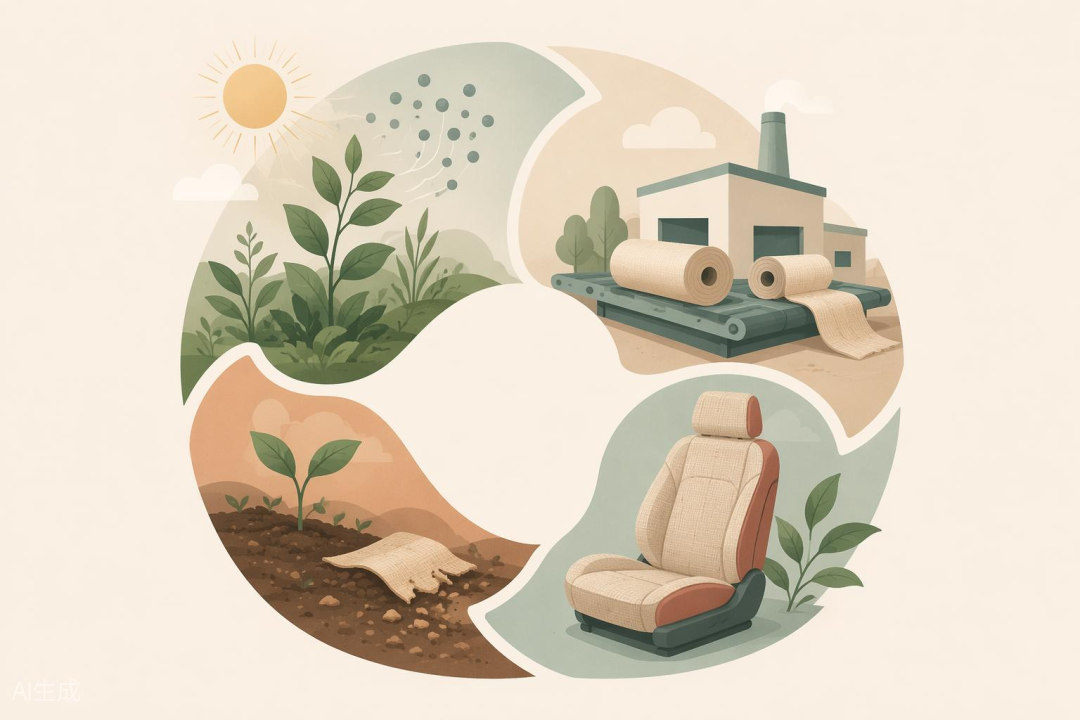
The closed carbon loop

That is the weight behind the words “bio-based”: it doesn’t ask the material to become weaker, slower, or cheaper — it just swaps in a smarter source of carbon.
Three Easily Confused Concepts
PURE®
Bio-based ≠ Biodegradable
“Bio-based” describes where the feedstock comes from (biomass or petroleum); “biodegradable” describes where the material ends up after disposal (whether microbes can break it down).

Comparative properties of bio-based PE, PLA/PHA, and PBAT

This is especially important for cars — components are expected to last more than ten years, so “biodegradable” becomes a drawback rather than a benefit. The mainstream of automotive bio-based materials is in fact “bio-based but non-biodegradable” durable grades — a green carbon source with no performance compromise.
Bio-based ≠ Water-based / Solvent-free
Bio-based addresses the “feedstock side” — where the carbon comes from. Water-based / solvent-free addresses the “production side” — whether the process emits organic solvents such as DMF or toluene. The two routes can stack — a bio-based feedstock combined with a water-based process produces a synthetic leather that delivers “double green.”
Plant Leather ≠ Vegetable-tanned Leather
“Cactus leather” and “pineapple leather” are artificial leathers built from a scaffold of plant fibers filled with resin — containing no animal ingredients whatsoever. Vegetable-tanned leather, by contrast, is an ancient process that tans animal hides with tannic acid: genuine leather by definition.
How to Prove a Material is
Truly “Bio-based”?
PURE®
Marketing claims won’t get you there; science has its “ruler”: the carbon-14 test.
The principle is elegant: every living organism contains trace amounts of radioactive carbon-14, which plants continually replenish from the atmosphere through photosynthesis. Petroleum, buried underground for hundreds of millions of years, has long since had all of its carbon-14 decayed away. Measuring the carbon-14 content of a material lets you precisely quantify what fraction of its carbon comes from biomass — this is the international standard ASTM D6866.

The carbon-14 test, principle

Building on this test, countries have set up certification systems: the USDA BioPreferred label in the United States, DIN certification in Germany, and Belgium’s OK biobased label (rating biomass-based carbon content from one to four stars).
For buyers, third-party certificates are the key tool that turns a “green claim” into a “verifiable clause” —
The Value Chain:
From a Stalk of Corn to a Car Seat
PURE®
Let’s pull the camera back and look at the full value chain. It divides clearly into three segments:upstream biomass feedstock → midstream material manufacturing → downstream automotive applications.
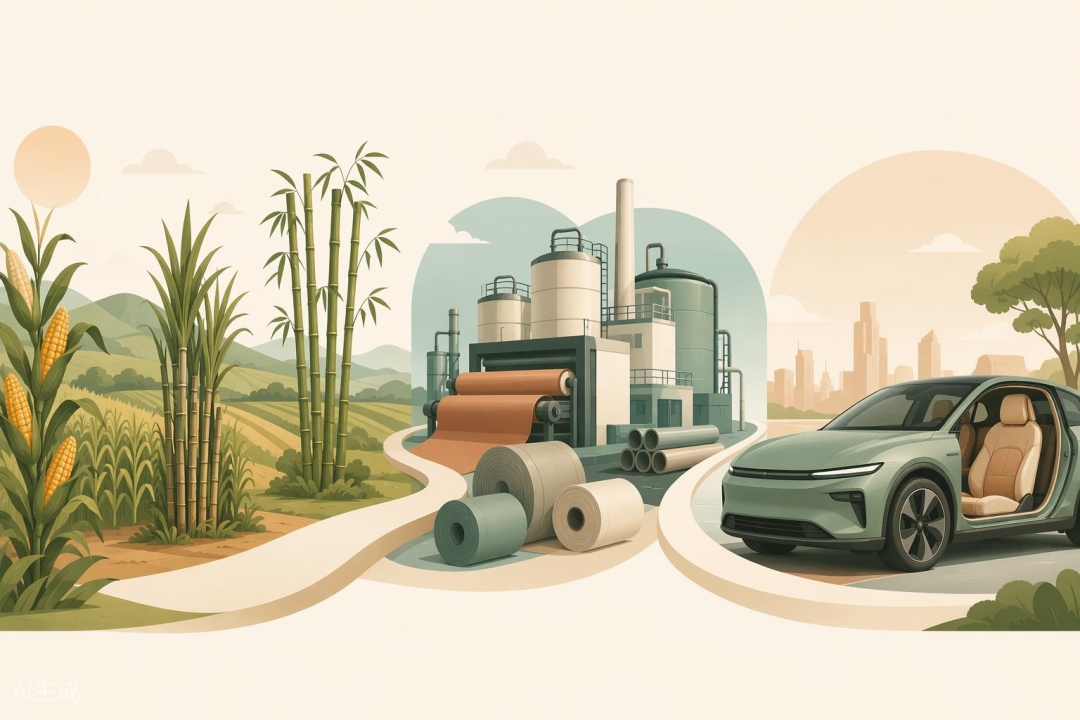
Overview of the three value-chain segments

Upstream: biomass feedstock, the “supplier” of carbon.
Starches & Sugars — corn, sugarcane, wheat. Widely available, technically mature, and the dominant carbon source at this stage.
Non-food Biomass — straw, bamboo and timber, agricultural and forestry residues. The national “Three-Year Action Plan for Accelerating Innovation and Development of Non-food Bio-based Materials” explicitly backs this route, sidestepping the “competing with grain for land” controversy.
Oils & Fats — castor oil, soybean oil, palm oil, and used cooking oil, key feedstocks for bio-based polyurethanes and bio-based nylons.
Microbial Resources — gene-edited engineered strains directly “ferment” material monomers. This is the main battleground of synthetic biology, and the segment where costs have been falling fastest in recent years.
This segment also gives birth to critical monomers such as lactic acid (PLA), pentanediamine, long-chain diacids, and bio-based polyols — the segment with the highest technical barriers and the most concentrated supplier base. Take bio-based polyols: the world’s top three producers account for roughly 30% of the market. Whoever controls the monomers controls pricing power.
Midstream: material manufacturing — turning monomers into usable materials.
Midstream companies polymerize the upstream monomers into resins, then process them into end-material forms such as plastics, fibers, rubber, coatings, and synthetic leather.
In the synthetic-leather sub-segment, midstream greening takes three concurrent paths:Water-based process(replaces organic solvents with water),Solvent-free process(reactive forming at near 100% solids),Bio-based feedstock (corn, bamboo fiber, spent coffee grounds replacing petroleum-based feedstocks) — the three can be stacked to deliver “double green” or even “triple green” solutions.
In the midstream of this chain,Changfeng New Materials is a working example of the “three concurrent paths”: the water-based process replaces DMF and other organic solvents; the solvent-free process reacts at near 100% solids; and on the feedstock side, biomass such as corn, bamboo fiber, and spent coffee grounds replaces petroleum-based ingredients. Stacking all three on the same piece of synthetic leather answers “where the carbon comes from” and “what the process emits” in one shot — this is the “water-based, solvent-free × bio-based” triple-green route.

PURE®Aerial view of the Changfeng New Materials plant

For OEMs, the value of this kind of supplier isn’t just handing over a green label — it’s making the cabin’s low-carbon story measurable, traceable, and writeable into procurement clauses.
Meanwhile, dedicated green synthetic-leather clusters have emerged in China — such as Zhejiang’s Lishui Economic Development Zone — with increasingly complete coverage from resin and base fabric to finished leather.
Downstream: applications, with automotive being one of the most important growth markets.
The EU End-of-Life Vehicles (ELV) regulation and China’s “dual-carbon” goals have forced OEMs to run a “carbon ledger” on every material. Cabin odor and VOC complaints have long topped customer-complaint lists, making the “healthy cabin” a new selling point. And “vegan interiors” have become a trend in Europe and the U.S., now flowing back into China with the new-energy brands.
Drilling down to specific components: seat foam (Ford’s soybean-oil-based foam, installed in over 15 million vehicles to date); interior fabric and synthetic leather (NIO’s bio-based microfiber); door panels and headliners (Mercedes’s natural-fiber composites); fuel lines (Arkema’s PA11); even battery enclosures (a Cathay–CATL joint venture plans an annual capacity of 2.5 million sets).
One signal: midstream material suppliers are starting to lock in downstream partnerships — forming JVs and co-development deals with battery makers and OEMs to absorb capacity through anchoring top-tier end customers and shorten automotive-grade validation cycles.
The Four Questions OEMs Care About Most
PURE®
With the concept and the value chain covered, let’s switch perspective — what OEMs really care about boils down to four questions.
Will the Performance Hold Up?
The answer is more optimistic than you might expect. Take synthetic leather: PU leather outperforms genuine leather in abrasion resistance (19,000 cycles on the Taber test without breakthrough, vs. ~1,800 cycles for genuine leather), folding endurance, and dimensional stability. Bio-based polyurethane matches petroleum-based polyurethane in mechanical performance, with the gap mainly being the bio-based content level. Introducing these materials to vehicle specifications still requires long-cycle validation — hydrolysis resistance, aging resistance, VOC — a question of time, not a technical roadblock.
Is the Supply Chain Mature?
On the upstream monomer side, BASF, Covestro, Wanhua, and Cathay have all established positions and keep expanding capacity. Midstream manufacturing has built distinctive industrial clusters in China. Downstream validation has cleared the automotive-grade route with mass-production or near-mass-production cases at NIO, BMW, Mercedes, and Ford.This value chain has moved from “whether it exists” to “how good it is, and how expensive.”
How Much More Does It Cost?
There is a premium, but it is narrowing rapidly — the industry broadly expects cost parity by 2030. It’s easier to reason within the synthetic-leather frame: synthetic leather already runs about 78% cheaper than genuine leather, and the bio-based variant adds only a modest premium while delivering “genuine-leather-grade hand feel + a quantifiable low-carbon story + an odor-free experience” all at once.
Where Is Policy Pointing?
Very clearly. The national “14th Five-Year Plan for the Bioeconomy” has listed bio-based materials as a priority direction, and the Six-Ministry “Three-Year Action Plan for Accelerating Innovation and Development of Non-food Bio-based Materials” sets a target of cost parity with fossil-based products for some non-food grades by 2025.
Standards are also landing —in 2025, China’s first eco-grade certification standard for synthetic leather was released — for the first time, bio-based content is graded alongside formaldehyde, DMF, and VOCs. Green now has a "grade," and procurement can source by grade.
Bio-based materials are not some distant concept — they are an ongoing restructuring of the value chain.
They rebuild “where the carbon comes from” on the feedstock side, “the boundary of what the process emits” on the production side, and “the definition of luxury” on the product side. Future premium cabins will no longer be benchmarked solely by leather origin and tanning process, but by carbon footprint, bio-based content, and health index.
For OEMs, the question isn’t “whether to use” but “when to start, and in which component.” The technology has been de-risked, the supply chain has taken shape, costs are narrowing, and standards are landing. The window is opening right now.
For material suppliers, those who can answer “where the carbon comes from, what the process emits, and what the user smells” all at once will hold the strongest position. That is also whyPURE®Changfeng New Materials chose the “100% water-based, solvent-free × bio-based” triple-green route: the feedstock comes from corn, bamboo fiber, and spent coffee grounds; production uses water instead of solvents; and the user smells nothing out of place.
Source material in this article is gathered from the web; images are AI-generated.
Please contact us for removal if anything is inappropriate.
PURE®
Making Materials More Sustainable